What process allowed new states to join the union?
Admission to the Wedlock is provided by the New States Clause of the United States Constitution in Article Iv, Section three, Clause ane, which authorizes the U.s. Congress to admit new states into the Union across the xiii states that already existed when the Constitution came into effect. The Constitution went into effect on June 21, 1788 in the nine states that had ratified information technology, and the U.S. federal regime began operations under information technology on March 4, 1789, when it was in issue in xi of the 13 states.[1] Since and then, 37 states take been admitted into the Matrimony. Each new state has been admitted on an equal footing with those already in existence.[2]
Of the 37 states admitted to the Marriage by Congress, all just vi take been established within existing U.S. organized incorporated territories. A state that was so created might embrace all or function of a territory. When the people of a territory or a region take grown to a sufficient population and have fabricated their want for statehood known to the federal government, Congress in well-nigh cases has passed an enabling act, authorizing the people of that territory or region to frame a proposed state constitution as a step toward admission to the Union. The use of an enabling human action has been a mutual celebrated exercise, but several states were admitted to the Union without one.
In many instances, an enabling human action would detail the machinery by which the territory would be admitted as a state after the ratification of their constitution and the election of country officers. Although the employ of such an human activity is a traditional historic practise, several territories have drafted constitutions for submission to Congress absent an enabling act but were afterwards admitted. The broad outline for the procedure was established by the Land Ordinance of 1784 and the 1787 Northwest Ordinance, both of which predate the U.South. Constitution.
The Access to the Wedlock Clause forbids the creation of new states from parts of existing states without the consent of all of the afflicted states and that of Congress. The chief intent of the caveat was to requite the four Eastern States that nonetheless had western land claims (Connecticut, Georgia, Northward Carolina, and Virginia) a veto over whether their western counties could become states.[3] The clause has since served the same function each time that a proposal to partition an existing country or states has arisen.
Text [edit]
Article Four, Department three, Clause i:
New States may be admitted by the Congress into this Spousal relationship; merely no new State shall be formed or erected within the Jurisdiction of any other State; nor any Land be formed past the Junction of two or more States, or Parts of States, without the Consent of the Legislatures of the States concerned as well as of the Congress.[4]
Groundwork [edit]
Articles of Confederation [edit]
Between 1781 and 1789, the United States was governed by a unicameral Congress, the Congress of the Confederation, which operated under authority granted to it by the Manufactures of Confederation, the nation'south first constitution. The 11th Article authorized Congress to admit new states to the Union provided ix states consented. Under the Articles, each state cast one vote on each proposed mensurate in Congress.
During this period, the Confederation Congress enacted ii ordinances governing the admission of new states into the Union. The outset such ordinance was the Country Ordinance of 1784, enacted April 23, 1784.[v] Thomas Jefferson was its principal author. The ordinance chosen for the land (recently confirmed as role of the U.s. by the Treaty of Paris) westward of the Appalachian Mountains, due north of the Ohio River and east of the Mississippi River to eventually be divided into ten states. Once a given area reached 20,000 inhabitants, it could call a ramble convention and course a provisional government. Then, upon enacting a country constitution which affirmed that the new state would forever be part of the Confederation, it would be admitted on an equal footing with all other states, based on a majority vote in Congress.[5] Stipulations for new state dictated that information technology would be bailiwick to the Articles of Confederation and acts of Congress; would be discipline to payment for federal debts; would not tax federal backdrop within the land edge or revenue enhancement non-residents at a rate higher than residents; and would accept a republican form of government.[5] Jefferson's original draft of the ordinance gave names to the proposed states and independent a provision that "Afterward the year 1800 there shall be neither slavery nor involuntary servitude in any of them."[6]
The 1784 ordinance was superseded iii years afterward past the Northwest Ordinance of 1787. Enacted by the Confederation Congress on July xiii, 1787, it created the Northwest Territory, the first organized incorporated territory of the United States. The Northwest Ordinance (Article V) provided for the access of several new states from inside its premises:
There shall be formed in the said territory, not less than three nor more than 5 States [...] And, whenever whatever of the said States shall have sixty thousand free inhabitants therein, such State shall be admitted, by its delegates, into the Congress of the United states, on an equal ground with the original States in all respects whatever, and shall be at liberty to course a permanent constitution and State regime: Provided, the constitution and government so to be formed, shall be republican, and in conformity to the principles independent in these articles; and, so far as it tin can be consequent with the general interest of the confederacy, such admission shall be allowed at an earlier menstruum, and when there may be a less number of free inhabitants in the Country than sixty thousand.[7]
While the Manufactures of Confederation were in upshot, the Congress considered diverse ordinances admitting particular new states into the Union, none of which were approved:
- On Baronial xx, 1781, Congress passed a resolution stating conditions under which the Vermont Republic (at the time a de facto but unrecognized sovereign state) could enter the Marriage. It needed only to give up its claims to territory west of Lake Champlain and e of the Connecticut River.[eight] In February 1782, the legislature of Vermont agreed to those terms. However, Vermont's admission was opposed by New York, which asserted a disputed merits to the region and consequently successfully resisted the proposed admission.
- On May 16, 1785, a resolution to admit Frankland (later modified to Franklin) to the Marriage was introduced in Congress. Eventually, seven states voted to admit what would take been the 14th land. This was, notwithstanding, fewer than the ix states required by the Articles of Confederation. The proposed state was located in what is today East Tennessee and within the territory due west of the Appalachian Mountains that had been offered past North Carolina every bit a cession to Congress to assistance pay off debts related to the Revolutionary War. It connected to exist equally an extra-legal state through mid-1788, when Due north Carolina reassumed total sovereignty over the expanse. In 1790, when North Carolina again ceded the region, the area that comprised Franklin became role of the Southwest Territory, the forerunner to the state of Tennessee.
- In July 1788, Congress began deliberations on whether to admit Kentucky to the Spousal relationship.[9] Kentucky was and so a part of Virginia. The legislature of Virginia had consented to the cosmos of the new state from its western district. However, when Congress began to talk over the thing, they received notification that New Hampshire had ratified the Constitution, becoming the ninth country to exercise so, causing it to go into effect in the ratifying states. Congress instead passed a resolution stating that it was "unadvisable" to acknowledge a new state under those circumstances and the thing should wait until the federal authorities under the Constitution came into existence.
Considered ane of the most important legislative acts of the Confederation Congress,[ten] the Northwest Ordinance established the precedent by which the Federal government would exist sovereign and expand westward with the admission of new states, rather than with the expansion of existing states and their established sovereignty under the Articles of Confederation. No new states were formed in the Northwest Territory under either ordinance. In 1789, the 1st Us Congress reaffirmed the Northwest Ordinance with slight modifications.[xi] The Northwest Territory remained in beingness until 1803, when the southeastern portion of it was admitted to the Wedlock every bit the Country of Ohio, and the remainder was reorganized.
1787 Constitutional Convention [edit]
At the 1787 Constitutional Convention, a proposal to include the phrase "new States shall exist admitted on the same terms with the original States" in the new states clause was defeated. That proposal would accept taken the policy articulated in the Ordinance of 1784 and fabricated it a constitutional imperative. Many delegates objected to including the phrase, fearing that the political power of future new western states would ultimately overwhelm that of the established eastern states.
Delegates, understanding that the number of states would inevitably increase,[12] did hold to include wording into this clause to prevent formation of a new state out of an established i without the consent of the established country every bit well every bit the Congress.[3] It was predictable that Kentucky (which was a part of Virginia), Franklin (which was a part of Due north Carolina, and later became part of the Southwest Territory), Vermont (to which New York asserted a disputed merits), and Maine (which was a function of Massachusetts), would become states. As a issue of this compromise, new breakaway states are permitted to bring together the Marriage but only with the proper consents.[13]
Equal footing doctrine [edit]
Shortly after the new Constitution went into effect Congress admitted Vermont and Kentucky on equal terms with the existing 13 states and thereafter formalized the condition in its acts of admission for subsequent states. Thus the Congress, utilizing the discretion allowed by the framers, adopted a policy of equal status for all newly admitted states.[3] The constitutional principle derived from these actions is known as the equal basis doctrine. With the growth of states' rights advocacy during the antebellum catamenia, the Supreme Court asserted, in Lessee of Pollard 5. Hagan (1845), that the Constitution mandated admission of new states on the basis of equality.[2]
Admission procedure [edit]
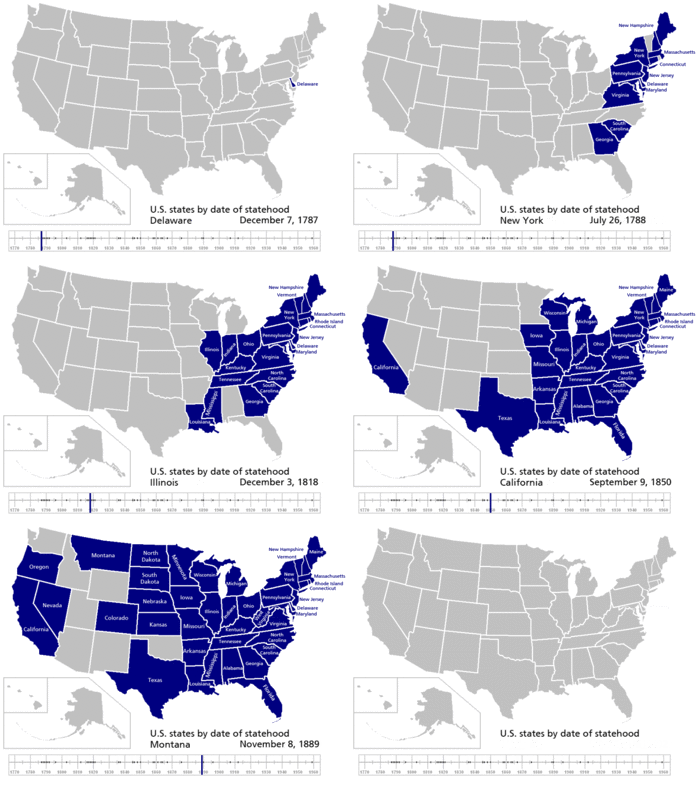
The order in which the original 13 states ratified the constitution, then the guild in which the others were admitted to the wedlock.
Historically, most new states formed by Congress have been established from an organized incorporated U.S. territory, created and governed by Congress in accord with its plenary power nether Article IV, Section 3, Clause ii of the Constitution.[14] In some cases, an entire territory became a country; in others some part of a territory became a state. In most cases, the organized authorities of a territory made known the sentiment of its population in favor of statehood, usually by referendum. Congress and then empowered that government to organize a constitutional convention to write a state constitution. Upon acceptance of that constitution, by the people of the territory and so by Congress, Congress would adopt past unproblematic bulk vote a joint resolution granting statehood. Then the President of the United States would sign the resolution and event a declaration announcing that a new land had been added to the Union. While Congress, which has ultimate authority over the access of new states, has usually followed this procedure, there have been occasions when it did not.[15] [sixteen] [17]
Congress is under no obligation to admit states, even in those areas whose population expresses a desire for statehood. In i instance, Mormon pioneers in Salt Lake Metropolis sought to establish the state of Deseret in 1849. Information technology existed for slightly over 2 years and was never approved by the Congress. In 1905, leaders of the Five Civilized Tribes (Cherokee, Chickasaw, Choctaw, Creek, and Seminole) in Indian Territory proposed to establish the country of Sequoyah equally a ways to retain control of their lands.[18] The proposed constitution ultimately failed in Congress. Instead, the Indian Territory was incorporated into the new state of Oklahoma in 1907.
Some U.S. territories existed only a short time before becoming states, while others remained territories for decades. The shortest-lived was Alabama Territory at 2 years, while New Mexico and Hawaii territories both were in existence for more than than fifty years. The entry of several states into the Union has been delayed by complicating factors. Amidst them, Michigan Territory, which petitioned Congress for statehood in 1835, was not admitted to the Union until 1837, considering of a boundary dispute with the adjacent state of Ohio. The contained Republic of Texas requested annexation to the United States in 1837, but fears nigh potential conflict with United mexican states delayed the admission of Texas for ix years.[xix] Also, statehood for Kansas Territory was held up for several years (1854–1861) considering of a series of internal violent conflicts involving anti-slavery and pro-slavery factions.
Once established, most country borders have, with few exceptions, been generally stable. Notable exceptions include: the various portions (the Western land claims) of several original states ceded over a menses of several years to the federal authorities, which in plow became the Northwest Territory, Southwest Territory, and Mississippi Territory; the 1791 cession by Maryland and Virginia of land to create the District of Columbia (Virginia'southward portion was returned in 1847); and the cosmos, on at least three occasions, of a new land (Kentucky, Maine and West Virginia) from a region of an existing state (Vermont was created from what was disputedly claimed to be a role of New York and was not admitted until New York consented); 2 large additions to Nevada, which became a state in 1864, were fabricated in 1866 and 1867. There have been numerous pocket-sized adjustments to state boundaries over the years as a upshot of improved surveys, resolution of ambiguous or disputed boundary definitions, or small mutually agreed boundary adjustments for administrative convenience or other purposes.[xx] Ane notable example is the case New Bailiwick of jersey five. New York, in which New Jersey won roughly xc% of Ellis Island from New York in 1998.[21]
States that were never part of an organized U.Due south. territory [edit]

States that were never part of an organized U.S. territory.
In addition to the original 13, half-dozen subsequent states were never part of an organized incorporated U.S. territory:
- Vermont, admitted March four, 1791, was formed from the territory of the Vermont Republic (earlier known as the New Hampshire Grants). This territory was also claimed by New York. The resulting dispute led to the rise of the Green Mountain Boys and the later establishment of the Vermont Republic. New Hampshire's merits upon the land was extinguished in 1764 by royal society of George 3, and on March 6, 1790, the land of New York ceded its merits to Vermont for thirty,000 Castilian dollars.[22]
- Kentucky, admitted June one, 1792, was set off from Virginia (previously its western District of Kentucky counties). The Virginia General Assembly adopted legislation on Dec 18, 1789, separating its "District of Kentucky" from the residuum of the land and approving its statehood.[23] [24]
- Maine, admitted March xv, 1820, was set off from Massachusetts (previously the Commune of Maine, its northern exclave). The Massachusetts General Court passed enabling legislation on June 19, 1819, consenting to the separation of the District of Maine from the rest of the country (an action approved by the voters in Maine on July nineteen, 1819); and then, on February 25, 1820, passed a follow-up mensurate officially accepting the fact of Maine's imminent statehood.[23] The deed of Congress establishing Maine as the 23rd land was part of the Missouri Compromise of 1820.[25]
- Texas, admitted Dec 29, 1845, was formed from the territory of the Republic of Texas following the republic's annexation into the United States before in 1845.[26]
- California, admitted September ix, 1850, was formed from unorganized territory ceded to the United States by Mexico in the 1848 Treaty of Guadalupe Hidalgo at the end of the Mexican–American War. The Act of Congress establishing California as the 31st state was function of the Compromise of 1850.[27]
- West Virginia, admitted June 20, 1863, during the Civil War, was set off from Virginia (previously its northwestern trans-Allegheny region). The General Assembly of the Restored Government of Virginia passed an human action on May 13, 1862, granting permission for the creation of Due west Virginia.[28] [29] Later, by its ruling in Virginia 5. Westward Virginia (1871), the Supreme Court implicitly affirmed that the breakaway Virginia counties did accept the proper consents required to become a separate country.[30]
Run across likewise [edit]
- 51st land
- An Human activity for the Admission of the State of California
- Enabling Act of 1802, authorizing residents of the eastern portion of the Northwest Territory to grade the state of Ohio
- Legal status of Texas
- Enabling Act of 1889, authorizing residents of Dakota, Montana, and Washington territories to form state governments (Dakota to be divided into two states) and to gain admission to the Union
- Enabling Act of 1906 authorizing residents of Oklahoma, Indian, New Mexico, and Arizona territories to class country governments (Indian and Oklahoma territories to be combined into one state) and to gain admission to the Wedlock
- Alaska Statehood Act, albeit Alaska as a state in the Marriage every bit of Jan three, 1959
- Hawaii Admission Act, admitting Hawaii equally a state in the Matrimony as of August 21, 1959
- Federalism in the United States
- Listing of U.Southward. states by date of admission to the Matrimony
- List of U.South. country partition proposals
- Perpetual Matrimony
- State cessions
- Statehood movement in the District of Columbia
- Statehood motility in Puerto Rico
References [edit]
- ^ "March iv: A forgotten huge day in American history". Constitution Daily. Philadelphia: National Constitution Center. March 4, 2013. Retrieved Oct 21, 2015.
- ^ a b "Doctrine of the Equality of States". Justia.com. Mountain View, California. Retrieved April 5, 2016.
- ^ a b c Forte, David F. "Essays on Commodity Four: New States Clause". The Heritage Guide to the Constitution. Washington, D.C.: The Heritage Foundation. Retrieved April 5, 2016.
- ^ "The Constitution of the Usa of America: Analysis and Interpretation, Centennial Edition, Interim Edition: Analysis of Cases Decided by the Supreme Court of the Usa to June 26, 2013" (PDF). Washington, DC: U.S. Government Printing Role. 2013. pp. 16–17. Retrieved April 5, 2016.
- ^ a b c Grupo de Investigadores Puertorriqueños (1984). Breakthrough From Colonialism: An Interdisciplinary Study of Statehood. Vol. 1. University of Puerto Rico. pp. 20–22. ISBN9780847724895. OCLC 836947912.
- ^ "Report from the Commission for the Western Territory to the U.s. Congress". Envisaging the West: Thomas Jefferson and the Roots of Lewis and Clark. University of Nebraska–Lincoln and University of Virginia. March 1, 1784. Retrieved April 7, 2016.
- ^ "Northwest Ordinance; July 13, 1787". Avalon Project. Lillian Goldman Law Library, Yale Law School. Retrieved Feb 17, 2014.
- ^ Mello, Robert A. (2014). Moses Robinson and the Founding of Vermont. Vermont Historical Society.
- ^ Vasan, Kesavan (2002). "When did the Articles of Confederation Stop to Be Police force?". Notre Dame Law Review. 78 (1).
- ^ "Northwest Ordinance". loc.gov. Washington, D.C.: Library of Congress. Retrieved Apr 19, 2016.
- ^ Horsman, Reginald (Autumn 1989). "The Northwest Ordinance and the Shaping of an Expanding Republic". The Wisconsin Magazine of History. Wisconsin Historical Society. 73 (1): 21–32. JSTOR 4636235.
- ^ "Madison Debates, July 23, 1787". New Haven, Connecticut: Lillian Goldman Law Library, Yale Law School. Retrieved August 20, 2016.
- ^ Kesavan, Vasan; Paulsen, Michael Stokes (March 2002). "Is West Virginia Unconstitutional?". California Law Review. Academy of California, Berkeley, School of Law. xc (2): 395. doi:10.2307/3481282. JSTOR 3481282. Retrieved March 25, 2018.
- ^ "Holding and Territory: Powers of Congress". Justia.com. Mount View, California. Retrieved April 8, 2016.
- ^ Huddle, F. P. (1946). "Admission of new states". Editorial research reports. CQ Press. Retrieved May 17, 2017.
- ^ "How Does a Territory Become a State?". www.puertoricoreport.com. Puerto Rico Report. Nov 23, 2018. Retrieved November 27, 2019.
- ^ "The last fourth dimension Congress created a new state". constitutioncenter.org. Philadelphia, Pennsylvania: National Constitution Center. March 12, 2020. Retrieved Nov nine, 2020.
- ^ "The Choctaw". Museum of the Carmine River. 2005. Archived from the original on June 15, 2009. Retrieved August 4, 2009.
- ^ Winders, Richard Bruce (2002). Crisis in the Southwest: the The states, Mexico, and the Struggle over Texas. Rowman & Littlefield. pp. 82, 92. ISBN978-0-8420-2801-1 – via Google Books.
- ^ Stein, Mark (2008). How u.s. Got Their Shapes. New York: HarperCollins. pp. xvi, 334. ISBN9780061431395.
- ^ Greenhouse, Linda (May 27, 1998). "The Ellis Isle Verdict: The Ruling; High Court Gives New Jersey Most of Ellis Isle". The New York Times . Retrieved August two, 2012.
- ^ "The 14th Land". Vermont History Explorer. Barre, Vermont: Vermont Historical Society. Retrieved April five, 2016.
- ^ a b "Official Name and Status History of the several States and U.S. Territories". TheGreenPapers.com.
- ^ "Kentucky". history.com. A+E Networks. Retrieved March 25, 2018.
- ^ "Today in History – March xv: The Pine Tree State". Washington, D.C.: Library of Congress. Retrieved April 5, 2016.
- ^ "The Annexation of Texas, the Mexican-American State of war, and the Treaty of Guadalupe-Hidalgo, 1845–1848". history.state.gov. Washington, D.C.: Office of the Historian, Strange Service Establish, Usa Section of State. Retrieved September viii, 2019.
- ^ "California Admission Day September 9, 1850". parks.ca.gov. Sacramento, California: California Department of Parks and Recreation. Retrieved September 8, 2019.
- ^ Hagans, John Marshall (1891). Brief Sketch of the Erection and Formation of the State of Due west Virginia from the Territory of Virginia. Butler press Visitor. p. 73. Retrieved September 8, 2019 – via Internet Annal, digitized September xiv, 2006.
- ^ "A State of Convenience: The Creation of West Virginia, Chapter Twelve, Reorganized Authorities of Virginia Approves Separation". Wvculture.org. Due west Virginia Sectionalization of Culture and History. Archived from the original on April 7, 2010. Retrieved Apr 5, 2016.
- ^ "Virginia v. West Virginia 78 U.Southward. 39 (1870)". Justia.com. Mount View, California. Retrieved April 5, 2016.
Farther reading [edit]
- The Uniting States: The Story of Statehood for the 50 United States, 3 volumes, edited by Benjamin F. Shearer, Greenwood Press, Westport, Connecticut, 2004, ISBN 0-313-32703-three
Source: https://en.wikipedia.org/wiki/Admission_to_the_Union

Post a Comment for "What process allowed new states to join the union?"