If You Are Reviewing the Industry-low Industry-average and Industry-high Values for the Cost
Affiliate 3: Evaluating the External Environment
Evaluating the Manufacture
- Explain how five forces analysis is useful to organizations.
- Be able to offer an example of each of the five forces.
The Purpose of Five Forces Analysis
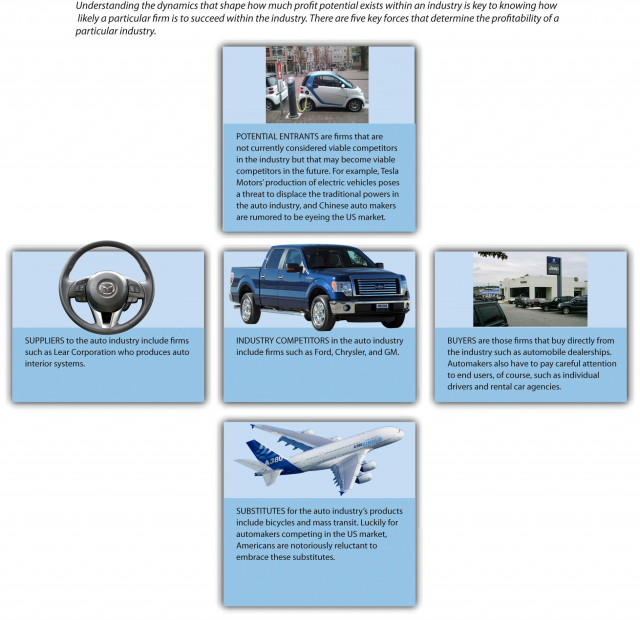
Visit the executive suite of any company and the chances are very high that the primary executive officer and the vice presidents are relying on to understand their industry. Introduced more than thirty years ago past Professor Michael Porter of the Harvard Business School, v forces analysis has long been and remains perhaps the most popular belittling tool in the business world (Figure 3.thirteen "Industry Assay").

The purpose of five forces assay is to place how much profit potential exists in an industry. To do so, five forces analysis considers the interactions among the competitors in an industry, potential new entrants to the manufacture, substitutes for the industry'south offerings, suppliers to the industry, and the industry's buyers (Porter, 1979). If none of these five forces works to undermine profits in the manufacture, and then the profit potential is very strong. If all the forces work to undermine profits, and then the turn a profit potential is very weak. Almost industries lie somewhere in between these extremes. This could involve, for example, all five forces providing firms with modest help or two forces encouraging profits while the other 3 undermine profits. In one case executives determine how much profit potential exists in an industry, they can and then determine what strategic moves to make to be successful. If the situation looks bleak, for case, one possible move is to exit the industry.
The Rivalry amidst Competitors in an Industry
The in an industry are firms that produce similar products or services. Competitors use a variety of moves such as advertising, new offerings, and price cuts to try to outmaneuver one another to retain existing buyers and to attract new ones. Because competitors seek to serve the same full general set of buyers, rivalry tin can get intense (Effigy iii.fifteen "Rivalry"). Subway faces tearing contest within the restaurant business, for example. This is illustrated by a quote from the man who built McDonald's into a worldwide icon. Old CEO Ray Kroc allegedly once claimed that "if any of my competitors were drowning, I'd stick a hose in their mouth." While this sentiment was (hopefully) just a figure of spoken language, the announcement in March 2011 that Subway had surpassed McDonald's in terms of numbers of stores might have increased McDonald's hostility toward its rival.
High levels of rivalry tend to reduce the profit potential of an industry. A number of characteristics that affect the intensity of the rivalry amid competitors are described below.
Rivalry among existing competitors tends to exist high to the extent that…
- Competitors are numerous or are roughly equal in size and power. As such, no 1 firm rules the manufacture, and cutthroat moves are likely as firms jockey for position.
- The growth charge per unit of the manufacture is irksome. A shortage of new customers leads firms to steal each other's customers.
- Competitors are not differentiated from each other. This forces firms to compete based on cost rather than based on the uniqueness of their offerings.
- Fixed costs in the industry are loftier. These costs must exist covered, even if it ways slashing prices in order to practice so.
- Exit barriers are high. Firms must stay and fight rather than leaving the industry gracefully.
- Excess capacity exists in the manufacture. When also much of a product is bachelor, firms must work hard to earn sales.
- Capacity must be expanded in large increments to be efficient. The high costs of adding these increments needs to exist covered.
- The product is perishable. Firms demand to sell their wares earlier they spoil and become worthless.
Agreement the intensity of rivalry among an industry's competitors is important because the caste of intensity helps shape the industry's profit potential. Of particular business organisation is whether firms in an industry compete based on price. When competition is bitter and cutthroat, the prices competitors charge—and their turn a profit margins—tend to go down. If, on the other mitt, competitors avoid biting rivalry, then cost wars can exist avoided and profit potential increases.
Every industry is unique to some degree, but at that place are some general characteristics that help to predict the likelihood that violent rivalry will erupt. Rivalry tends to be fierce, for example, to the extent that the growth rate of demand for the industry's offerings is low (considering a lack of new customers forces firms to compete more than for existing customers), stock-still costs in the manufacture are high (because firms will fight to have plenty customers to cover these costs), competitors are non differentiated from ane another (considering this forces firms to compete based on cost rather than based on the uniqueness of their offerings), and in the industry are high (because firms do not have the option of leaving the manufacture gracefully). Go out barriers can include emotional barriers, such as the bad publicity associated with massive layoffs, or more objective reasons to stay in an industry, such as a desire to recoup considerable costs that might have been previously spent to enter and compete.
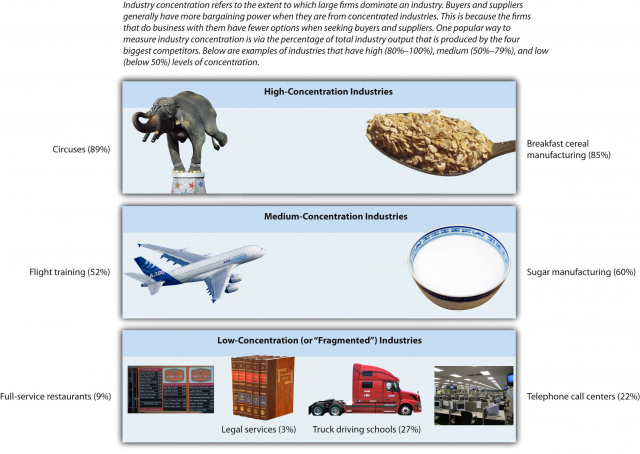
Industry concentration is an important aspect of competition in many industries. Industry concentration is the extent to which a small number of firms dominate an industry (Effigy 3.16: "Industry Concentration"). Amongst circuses, for example, the four largest companies collectively ain 89 percent of the marketplace. Meanwhile, these companies tend to keep their competition rather polite. Their advertising does non lampoon one another, and they practice not put on shows in the same city at the same fourth dimension. This does non guarantee that the circus industry volition be profitable; there are four other forces to consider besides as the quality of each firm'due south strategy. But low levels of rivalry certainly help build the profit potential of the industry.
In contrast, the restaurant industry is fragmented, meaning that the largest rivals control just a small fraction of the business concern and a large number of firms are important participants. Rivalry in fragmented industries tends to become bitter and fierce. Quiznos, a chain of sub shops that is roughly 15 percent the size of Subway, has aimed some of its advert campaigns directly at Subway, including ane depicting a fictional sub store called "Incorrect Way" that bore a strong resemblance to Subway.
Within fragmented industries, information technology is well-nigh inevitable that over time some firms will try to steal customers from other firms, such as by lowering prices, and that any competitive move by one firm will be matched by others. In the wake of Subway's success in offering foot-long subs for $5, for example, Quiznos has matched Subway's price. Such price jockeying is delightful to customers, of class, only information technology tends to reduce prices (and turn a profit margins) inside an industry. Indeed, Quiznos after escalated its try to attract budget-minded consumers by introducing a flatbread sandwich that cost simply $two. Overall, when choosing strategic moves, Subway's presence in a fragmented manufacture forces the business firm to endeavour to anticipate not only how fellow eatery giants such as McDonald's and Burger King volition react but likewise how smaller sub store chains like Quiznos and various regional and local players will respond.
The Threat of Potential New Entrants to an Industry
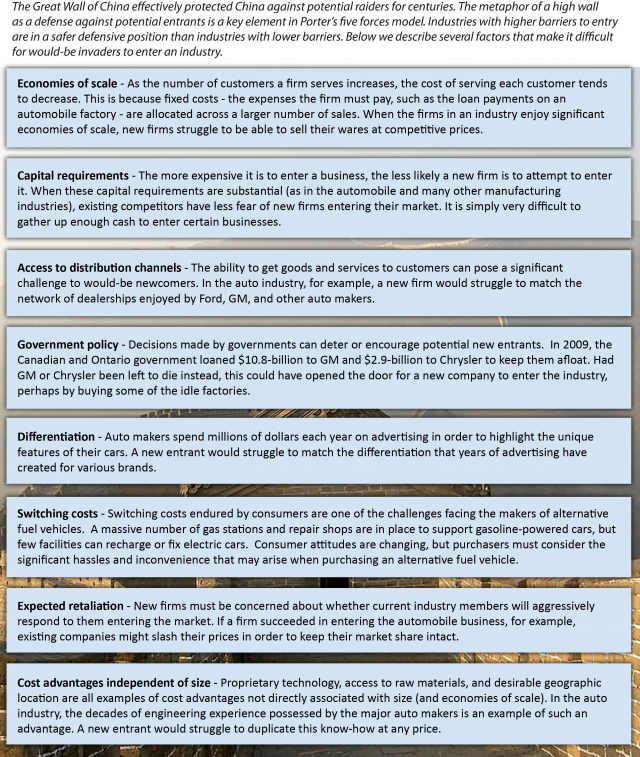
Competing within a highly profitable industry is desirable, merely information technology can as well concenter unwanted attending from outside the industry. are firms that do not currently compete in an industry but might join the industry in the future. (Effigy iii.17 "New Entrants"). New entrants tend to reduce the profit potential of an industry by increasing its competitiveness. If, for example, two new firms enter an industry consisting of five firms, this means that seven rather than 5 firms are at present trying to attract the same general pool of customers. Thus executives demand to clarify how likely it is that one or more new entrants will enter their industry every bit part of their effort to understand the profit potential that their industry offers.
New entrants can join the fray within an industry in several different ways. New entrants can be start-upwardly companies created by entrepreneurs, foreign firms that decide to enter a new geographic surface area, supplier firms that cull to enter their customers' business, or buyer firms that choose to enter their suppliers' business concern. The likelihood of these four paths being taken varies beyond industries. Restaurant firms such as Subway, for example, exercise not need to worry almost their buyers entering the manufacture because they sell directly to individuals, not to firms. It is also unlikely that Subway'south suppliers, such as farmers, will make a large splash in the eatery industry.

On the other manus, entrepreneurs launch new restaurant concepts every year, and i or more than of these concepts may evolve into a fearsome competitor. As well, competitors based overseas sometimes enter Subway'due south core markets. In 2008, U.Southward.-based Panera Breadstuff opened its beginning Canadian stores in Ontario. Panera Breadstuff operates more than 1,500 restaurants in the United States and over a dozen in Canada. Time will tell whether this new entrant has a significant effect on Subway and other restaurant firms. Considering a smokehouse turkey panini closely resembles a hamburger, McDonald's and Burger Male monarch may have more to fear from Panera than Subway does.
Every industry is unique to some degree, only some general characteristics help to predict the likelihood that new entrants will join an manufacture. New entry is less likely, for example, to the extent that existing competitors savour economies of scale (because new entrants struggle to friction match incumbents' prices), upper-case letter requirements to enter the manufacture are high (because new entrants struggle to assemble plenty cash to get started), admission to distribution channels is limited (considering new entrants struggle to get their offerings to customers), governmental policy discourages new entry, differentiation among existing competitors is high (considering each incumbent has a grouping of loyal customers that enjoy its unique features), switching costs are high (considering this discourages customers from buying a new entrant'southward offerings), expected retaliation from existing competitors is high, and cost advantages contained of size be.
The Threat of Substitutes for an Industry'due south Offerings
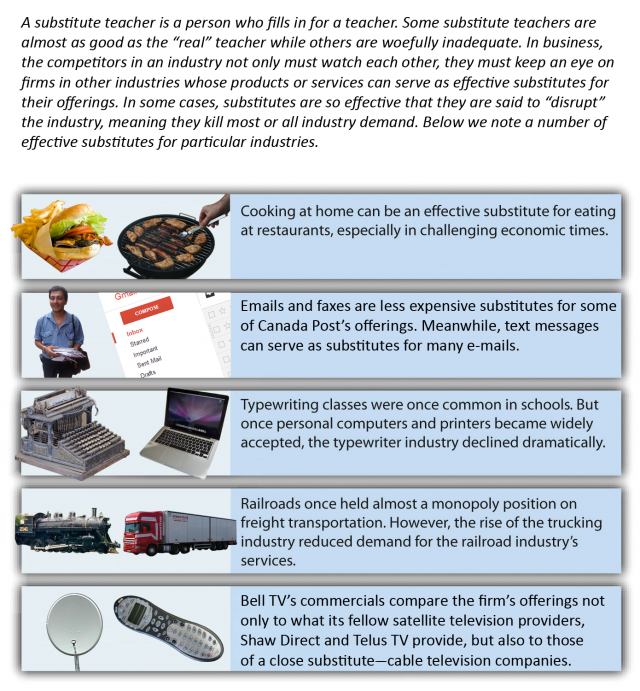
Executives need to take stock not only of their direct competition merely also of players in other industries that tin can steal their customers. are offerings that differ from the goods and services provided by the competitors in an industry but that make full similar needs to what competitors offer (Figure iii.19 "Substitutes"). How strong a threat substitutes are depends on how effective substitutes are in serving an industry's customers.
At offset glance, information technology could appear that the satellite television business is a tranquil one because in that location are simply two significant U.S. competitors—DIRECTV and DISH Network. These two industry giants, however, face a daunting challenge from substitutes. The closest substitute for satellite television is provided by cable idiot box firms, such every bit Comcast and Charter Communications. DIRECTV and DISH Network as well need to exist wary of streaming video services, such every bit Netflix, and video rental services, such every bit Redbox. The availability of viable substitutes places stringent limits on what DIRECTV and DISH Network can accuse for their services. If the satellite television firms enhance their prices, customers will be tempted to obtain video programs from culling sources. This limits the profit potential of the satellite television concern.
In other settings, feasible substitutes are not available, and this helps an industry'south competitors enjoy profits. Like lightbulbs, candles tin provide lighting within a home. Few consumers, still, would be willing to employ candles instead of lightbulbs. Candles simply exercise non provide as much calorie-free as lightbulbs. Besides, the risk of starting a burn down when using candles is far greater than the burn gamble when using lightbulbs. Because candles are a poor substitute, lightbulb makers such equally General Electrical and Siemens do not need to fear candle makers stealing their customers and undermining their profits.

The dividing line between which firms are competitors and which firms offer substitutes is a challenging issue for executives. Most observers would hold that, from Subway's perspective, sandwich-maker Quiznos should be considered a competitor and that grocery stores such as Safeway offering a substitute for Subway's offerings. But what near full-service restaurants, such as The Keg, and "fast casual" outlets, such every bit Panera Bread? Whether firms such as these are considered competitors or substitutes depends on how the industry is defined. Under a broad definition—Subway competes in the eating house business—The Keg and Panera should be considered competitors. Under a narrower definition—Subway competes in the sandwich business—Panera is a competitor and The Keg is a substitute. Under a very narrow definition—Subway competes in the sub sandwich business—both The Keg and Panera provide substitute offerings. Thus clearly defining a house's industry is an important footstep for executives who are performing a five forces assay.
The Power of Suppliers to an Industry
provide inputs that the firms in an manufacture need to create the appurtenances and services that they in plough sell to their buyers. A multifariousness of supplies are important to companies, including raw materials, financial resources, and labor (Figure 3.21 "Suppliers"). For eating place firms such as Subway, key suppliers include such firms as Sysco that bring various foods to their doors, restaurant supply stores that sell kitchen equipment, and employees that provide labor.
The relative bargaining power betwixt an industry's competitors and its suppliers helps shape the turn a profit potential of the industry. If suppliers have greater leverage over the competitors than the competitors have over the suppliers, so suppliers tin can increase their prices over time. This cuts into competitors' turn a profit margins and makes them less likely to exist prosperous. On the other manus, if suppliers take less leverage over the competitors than the competitors have over the suppliers, then suppliers may be forced to lower their prices over time. This strengthens competitors' profit margins and makes them more likely to exist prosperous. Thus when analyzing the profit potential of their industry, executives must carefully consider whether suppliers take the ability to demand college prices.
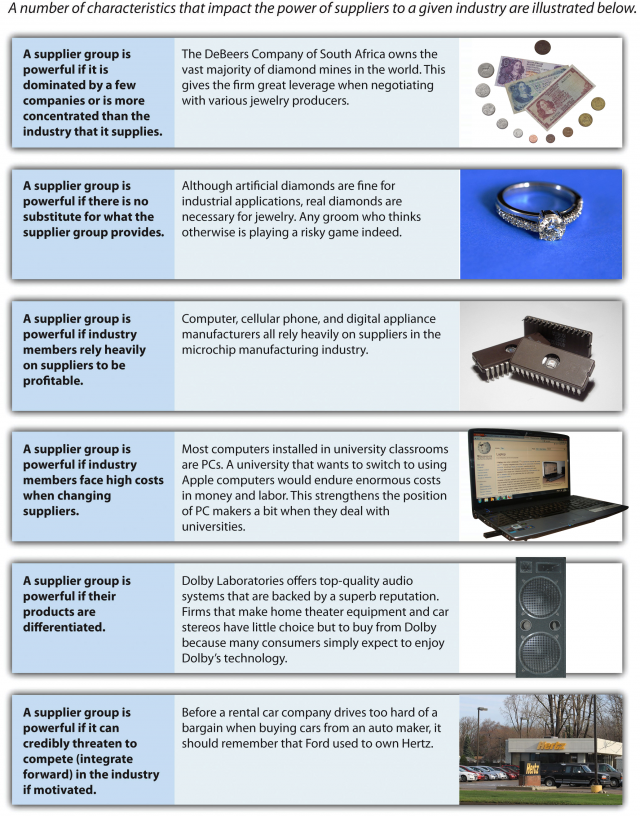
Every industry is unique to some degree, simply some general characteristics help to predict the likelihood that suppliers will be powerful relative to the firms to which they sell their goods and services. Suppliers tend to be powerful, for example, to the extent that the suppliers' industry is dominated by a few companies, it is more concentrated than the manufacture that information technology supplies and/or there is no effective substitute for what the supplier grouping provides. These circumstances restrict industry competitors' ability to shop around for better prices and put suppliers in a position of strength.
Supplier power is also stronger to the extent that industry members rely heavily on suppliers to exist profitable, industry members face loftier costs when irresolute suppliers, and suppliers' products are differentiated. Finally, suppliers possess power to the extent that they take the ability to become a new aspirant to the industry if they wish. This is a strategy called ,a strategy that involves a supplier entering the industry to which information technology supplies production. Ford, for instance, used a forrad vertical integration strategy when information technology purchased rental car visitor (and Ford client) Hertz. A difficult fiscal situation forced Ford to sell Hertz for $5.6 billion in 2005. But before rental car companies such as Avis and Thrifty drive too hard a deal when buying cars from an automaker, their executives should think that automakers are much bigger firms than rental car companies are. The executives running the automaker might simply decide that they want to savour the rental car company's profits themselves and acquire the firm.
Strategy at the Movies
Flash of Genius
When dealing with a large visitor, a small-scale supplier can go squashed like a bug on a windshield. That is what college professor and inventor Dr. Robert Kearns found out when he invented intermittent windshield wipers in the 1960s and attempted to supply them to Ford Motor Company. Equally depicted in the 2008 picture Flash of Genius, Kearns dreamed of manufacturing the wipers and selling them to Detroit automakers. Rather than buy the wipers from Kearns, Ford replicated the design. An aroused Kearns and so spent many years trying to hold the firm accountable for infringing on his patent. Kearns somewhen won in court, but he paid a terrible personal price forth the way, including a nervous breakdown and estrangement from his family. Kearns'southward lengthy battle with Ford illustrates the concept of bargaining power that is central to Porter'due south five forces model. Even though Kearns created an exceptional new product, he had little leverage when dealing with a massive, well-financed car manufacturer.

The Power of an Industry's Buyers
purchase the goods and services that the firms in an industry produce (Effigy three.23 "Buyers"). For Subway and other restaurants, buyers are individual people. In dissimilarity, the buyers for some firms are other firms rather than end users. For Procter & Gamble, for case, buyers are retailers such as Walmart and Target who stock Procter & Run a risk's pharmaceuticals, hair intendance products, pet supplies, cleaning products, and other household goods on their shelves.
A number of characteristics that impact the power of buyers to a given industry are illustrated beneath.
| A buyer group is powerful when at that place are relatively few buyers compared to the number of firms supplying the industry. | Buyers that buy a large percent of the seller's goods and services are more than powerful, as Walmart demonstrated by aggressively negotiating with suppliers over the years. |
| A heir-apparent group is powerful when the manufacture's goods or services are standardized or undifferentiated. | Subway can drive a hard deal when purchasing commodities such as wheat and yeast because one vendor'south wheat and yeast is typically identical to another vendor's. |
| A heir-apparent group is powerful when they face little or no switching costs in changing vendors. | Circuses can observe elephants, clowns, and trapeze artists from any source possible. This allows circus managers to store around for the best prices. |
| A buyer group is powerful when the practiced or service purchased by the buyers represents a high percentage of the buyer's costs, encouraging ongoing searches for lower-priced suppliers. | Virtually consumers pay little attention to prices when buying toothpaste, simply many spend hours exhaustively searching the Internet for data on automobile prices. |
| A buyer grouping is powerful if it can credibly threaten to compete (integrate backward) in the industry if motivated. | Ford and General Motors are well known for threatening to self-manufacture auto parts if suppliers practise non provide goods and services at acceptable prices. |
| A buyer grouping is powerful when the good or service purchased by buyer groups is of limited importance to the quality or cost of the buyer'southward offerings. | While stereo systems and tires are components that car buyers may be sensitive to when making a purchase determination, car manufacturers can buy glass and spark plugs from any vendor every bit long as they meet quality standards. This gives automakers leverage when negotiating with glass and spark plugs companies. |
The relative bargaining power between an industry's competitors and its buyers helps shape the profit potential of the industry. If buyers take greater leverage over the competitors than the competitors have over the buyers, then the competitors may be forced to lower their prices over time. This weakens competitors' profit margins and makes them less probable to be prosperous. Walmart is a good example. The mammoth retailer is notorious amongst manufacturers of appurtenances for enervating lower and lower prices over time (Bianco & Zellner, 2003). Walmart also launched an aggressive push to accept marketers divert their consumer media and marketing budgets into the giant retailer'south growing advertizement budget and in-shop marketing programs, using a simultaneous push to clear underperforming brands off its shelves as extra leverage. Walmart has the power to insist on cost concessions because its sales volume is huge (Neff, 2009). 1 product from i brand makes up a pocket-size portion of Walmart's overall sales, then a product exiting the marketplace would not hurt Walmart. From the perspective of the supplier, however, Walmart is their biggest heir-apparent. If the supplier were to reject to exercise business organisation with Walmart, they would miss out on admission to a large portion of consumers.
On the other hand, if buyers have less leverage over the competitors than the competitors accept over the buyers, then competitors tin raise their prices and enjoy greater profits. This description fits the textbook manufacture quite well. University and college students are often dismayed to learn that an assigned textbook costs $150 or more. Historically, textbook publishers have been able to charge high prices considering buyers had no leverage. A pupil enrolled in a grade must purchase the specific book that the professor has selected. Used copies are sometimes a lower-cost selection, only textbook publishers have cleverly worked to undermine the used textbook marketplace by releasing new editions after very short periods of time.
Of form, the presence of a very high profit industry is bonny to potential new entrants. Some publishers take entered the textbook market with lower-priced offerings. Too as open educational resources and open textbooks are additional depression-cost alternatives to the textbook market. Time will tell whether such offerings bring downwardly textbook prices. Like any new aspirant, upstarts in the textbook concern must testify that they can execute their strategies before they can gain widespread acceptance. Overall, when analyzing the profit potential of their manufacture, executives must carefully consider whether buyers have the ability to demand lower prices. In the textbook market at the moment, most buyers exercise non.

Every industry is unique to some degree, only some general characteristics aid to predict the likelihood that buyers will exist powerful relative to the firms from which they purchase goods and services. Buyers tend to be powerful, for example, to the extent that in that location are relatively few buyers compared with the number of firms that supply the manufacture, the industry's goods or services are standardized or undifferentiated, buyers face up little or no switching costs in changing vendors, the good or service purchased past the buyers represents a high percent of the buyer's costs, and the good or service is of limited importance to the quality or price of the heir-apparent's offerings.
Finally, buyers possess ability to the extent that they have the ability to become a new aspirant to the manufacture if they wish. This strategy is chosen , a strategy that involves a heir-apparent entering the industry that it purchases goods or services from. TiVo was the pioneer of digital video recorders. This situation changed, however, when media providers grew weary of their human relationship with TiVo. The media companies and then used a backward vertical integration strategy and started offering their own branded digital video recorders, ofttimes bundled with a range of services. Profits that used to be enjoyed past TiVo were transferred at that point to the media companies.
The Limitations of Five Forces Analysis
V forces assay is useful, only it has some limitations besides. The description of five forces analysis provided by its creator, Michael Porter, seems to presume that contest is a zilch-sum game, meaning that the amount of turn a profit potential in an industry is fixed. One implication is that if a firm is to make more turn a profit, it must accept that profit from a rival, a supplier, or a buyer. In some settings, notwithstanding, collaboration tin create a larger pool of profit that benefits everyone involved in the collaboration. In general, collaboration is a possibility that 5 forces analysis tends to downplay. The relationships among the rivals in an manufacture, for example, are depicted equally adversarial. In reality, these relationships are sometimes adversarial and sometimes collaborative. Full general Motors and Toyota compete fiercely all around the world, for case, merely they also have worked together in joint ventures. Similarly, five forces analysis tends to portray a firm'south relationships with its suppliers and buyers equally adversarial, but many firms find ways to collaborate with these parties for mutual benefit. Indeed, concepts such as just-in-time inventory systems depend heavily on a firm working as a partner with its suppliers and buyers.
"How much profit potential exists in our industry?" is a central question for executives. Five forces analysis provides an reply to this question. It does this past considering the interactions among the competitors in an manufacture, potential new entrants to the industry, substitutes for the manufacture'due south offerings, suppliers to the manufacture, and the industry's buyers.
- What are the v forces?
- Is in that location an aspect of manufacture activity that five forces analysis seems to leave out?
- Imagine you are the president of your college or academy. Which of the v forces would exist most important to you? Why?
References
Bianco, B., & Zellner, W. (2003, October 6). Is Wal-Mart too powerful? Bloomberg Businessweek. Retrieved from http://www.businessweek.com/mag/content/03_40/b3852001_mz001.htm
Neff, J. (2009). Walmart Threatens Suppliers to Gain Their Promotion Dollars. Advertising Historic period. Retrieved from http://reclaimdemocracy.org/walmart_threatens_suppliers_for_marketing_dollars/
Porter, Thousand. East. (1979, March–April). How competitive forces shape strategy. Harvard Business Review, 137–156.
Prototype descriptions
Effigy 3.13 image description: Industry Analysis.
Understanding the dynamics that shape how much profit potential exists inside an industry is key to knowing how likely a detail firm is to succeed within the industry. At that place are 5 cardinal forces that decide the profitability of a particular industry.
- Potential entrants are firms that are not currently considered feasible competitors in the industry but that may become viable competitors in the future. For example, Tesla Motors' product of electric vehicles poses a threat to displace traditional powers in the machine industry, and Chinese motorcar makers are rumoured to be eyeing the American market.
- Suppliers to auto industry include firms such equally Lear Corporation who produces auto interior systems.
- Industry competitors in the machine industry include firms such equally Ford, Chrysler, and GM.
- Buyers are those firms that just directly from the manufacture such equally automobile dealerships. Automakers besides have to pay careful attending to end users, of grade, such as individual drivers and rental car agencies.
- Substitutes for the car industry'due south products include bicycles and mass transit. Luckily for automakers competing in the US market, Americans are notoriously reluctant to comprehend substitute.
[Return to Figure 3.13]
Figure 3.16 paradigm description: Industry Concentration.
Manufacture concentration refers to the extent to which large firms dominate an manufacture. Buyers and suppliers mostly have more bargaining power when they are from full-bodied industries. This is because the firms that practise business organisation with them take fewer options when seeking buyer and suppliers. One popular way to measure manufacture concentration is via the percentage of total industry output that is produced by the iv biggest competitors. Below are examples of industries that take high (lxxx percent to 100 percent), medium (50 percent to 79 percent), and low (below 50 percent) levels of concentration.
- High-concentration industries
- circuses – 89 percent
- breakfast cereal manufacturing 85 percent
- Medium-concentration industries
- flying preparation – 50 percent
- saccharide manufacturing threescore per centum
- Low-concentration (or fragmented) industries
- full-service eating house – 9 pct
- legal service – 3 pct
- truck driving schools – 27 pct
- telephone call centres – 22 pct
[Return to Figure 3.sixteen]
Effigy iii.17 paradigm clarification: New Entrants.
The Great Wall of China effectively protected China against potential raiders for centuries. The metaphor of a high wall equally a defence against potential entrants is a fundamental element in Porter's five forces model. Industries with higher barriers to entry are in a safer defensive position than industries with lower barriers. Beneath nosotros describe several factors that go far difficult for would-be invaders to enter an industry.
- Economies of scale – As the number of customers a firm serves increases, the toll of serving each client tends to subtract. This is because stock-still costs – the expenses the firm must pay, such as the loan payments on an machine factory – are allocated across a larger number of sales. When the firms in an manufacture relish significant economies of calibration, new firms struggle to be able to sell their wares at competitive prices.
- Capital letter requirements – The more expensive information technology is to enter a business organization, the less likely a new house is to attempt to enter information technology. When these capital letter requirements are substantial (equally in the automobile and many other manufacturing industries), existing competitors have less fearfulness of new firms entering their market place. It is but very difficult together upwards plenty greenbacks to enter certain businesses.
- Access to distribution channels – The power to get appurtenances and services to customers can pose a meaning challenge to would-exist newcomers. In the automobile industry, for instance, a new firm would struggle to lucifer the network of dealerships enjoyed by Ford, GM, and other motorcar makers.
- Authorities policy – made governments can deter or encourage potential new entrants. In 2009, the Canadian and Ontario authorities loaned SIDS-billion to GM and S2.nine•billion to Chrysler to go along them afloat. Had GM or Chrysler been left to die instead, this could have opened the door for a new company to enter the manufacture, perhaps buying some of the idle factories.
- Differentiation – Auto makers spend millions of dollars each yr on advertising in order to highlight the unique features of their cars. A new entrant would struggle to friction match the differentiation that years of advertising have created for various brands.
- Switching costs – Switching costs endured by consumers are one of the challenges facing the makers of culling fuel vehicles. A massive number of gas stations and repair shops are in place to back up gasoline-powered cars, only few facilities tin can recharge or ready electric cars. Consumer attitudes are changing, only purchasers must consider the significant hassles and inconvenience that may arise when purchasing an alternative fuel vehicles.
- Expected retaliation – New firms must be concerned almost whether current manufacture members will aggressively respond to them entering the market place. If a firm succeeded in entering the automobile concern, for case, existing companies might slash their toll in order to keep their market share intact.
- Cost advantages independent of size – Proprietary technology, access to raw material, and desirable geographic location are all examples of cost advantages not directly associated with size (and economies of calibration). In the auto industry, the decades of engineering feel possessed past the major auto makers is an example of such an advantage. A new entrant would struggle to duplicate this know-how at whatever price.
[Return to Figure 3.17]
Figure 3.19 image description: Substitutes.
A substitute teacher is a person who fills in for a instructor. Some substitute teachers are virtually equally good equally the "real" teacher while others are woefully inadequate. In business concern the competitors in an manufacture not only must watch each other, they firms in other industries whose products or services can serve as effective substitutes for their offerings. In some cases, substitutes are so effective that they are said to "disrupt" the industry, significant they impale nearly or all industry need. Below we note a number of effective substitutes for particular industries.
- Cooking at dwelling house tin can be an effective substitute for eating at restaurants, especially in challenging economic times.
- Emails and faxes are less expensive substitutes for some of Canada Post's offerings. Meanwhile, text messages can serve as substitutes for many e-mails.
- Typewriting classes were in one case common in schools. But once personal computers and printer became widely accepted, the typewriter manufacture declined dramatically.
- Railroads in one case held almost a monopoly position on freight transportation. Even so, the rise of the trucking industry reduced demand for the railroad industry services.
- Bong Idiot box's commercials compare the firm's offerings not only to what its fellow satellite television providers, Shaw Direct and Telus Television set provide, but as well to those of a close substitute – cable telly companies.
[Return to Figure 3.19]
Effigy three.21 image description: Suppliers.
A number of characteristics that bear on the ability of suppliers to a given manufacture are illustrated
- A supplier group is powerful if information technology is dominated by a few companies or is more full-bodied than the manufacture that it supplies. The DeBeers Company of Due south Africa owns the vast majority of diamond mines in the world. This gives the firm great leverage when negotiating with various jewelry producers.
- A supplier group is powerful if there is no substitute for what the supplier group provides. Although bogus diamonds are fine for industrial applications, existent diamonds are necessary for jewelry. Any groom who thinks otherwise is playing a risky game indeed.
- A supplier group is powerful if industry members rely heavily on suppliers to exist assisting. Figurer, cellular phone, and digital appliance manufacturers all rely heavily on suppliers in the microchip manufacturing industry.
- A supplier grouping is powerful if industry members face high costs when changing suppliers. Most computers installed in university classrooms are PCs. A university that wants to switch to using Apple computers would endure enormous costs in coin and labor. This strengthens the position of PC makers a flake when they deal with universities.
- A supplier grouping is powerful if their products are differentiated. Dolby Laboratories offers top-quality audio systems that are backed by a superb reputation. Firms that brand home theatres equipment and machine stereos have little choice but to buy from Dolby because many consumers simple await Dolby's technology.
- A supplier group is powerful if it can credibly threaten to compete (integrate frontwards) in the industry if motivated. Before a rental car company drives too hard of a deal when buying cars from an auto maker, it should remember that Ford used to own Hertz.
[Render to Effigy 3.21]
Source: https://opentextbc.ca/strategicmanagement/chapter/evaluating-the-industry/

Post a Comment for "If You Are Reviewing the Industry-low Industry-average and Industry-high Values for the Cost"